
Secret scanning
Stops credentials from leaving your organization inside a prompt. Default: warn. This is the detector most organizations move to block first, and the one where doing so is least controversial.
What it looks for
Recognizable, high-confidence credential formats:
- AWS access key IDs
- GitHub tokens and personal access tokens
- PEM private keys
- Anthropic API keys (
sk-ant-…) - OpenAI API keys (
sk-…,sk-proj-…) - Slack tokens
- Google API keys
- JSON Web Tokens
These are matched on shape, so the false-positive rate is low — but an example key in documentation your developer pasted will trip it, which is the right outcome anyway.
What is recorded
The kind and the count. Never the value. A finding says "one AWS access key id was present"; it does not store the key, an offset, or a preview. Building a security product that quietly collects a database of everybody's leaked credentials would be indefensible, so the detector is built so that it cannot.
The sensitivity dial does not apply
Detected secrets are handled according to this detector's action regardless of where the risk classifier sensitivity is set. The dial governs the semantic classifier, not pattern matching.
Setting it
Policy → Risk detectors → Secret scanning.
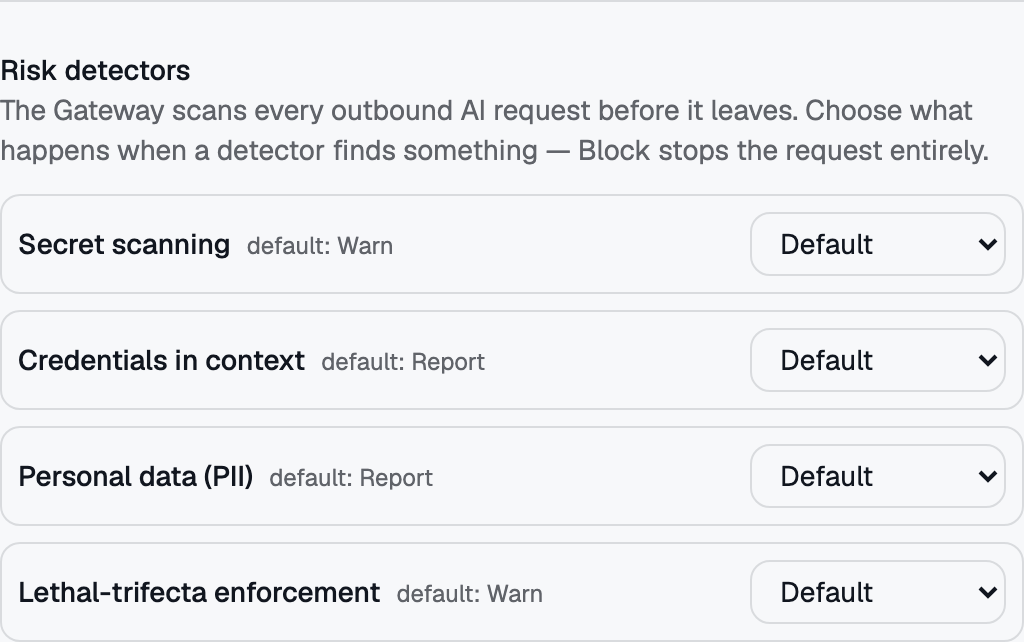 Secret scanning is the first row of Risk detectors. Each detector chooses its own action: Allow, Warn, Report or Block.
No comments to display
No comments to display